“Religion has become a luxury good”

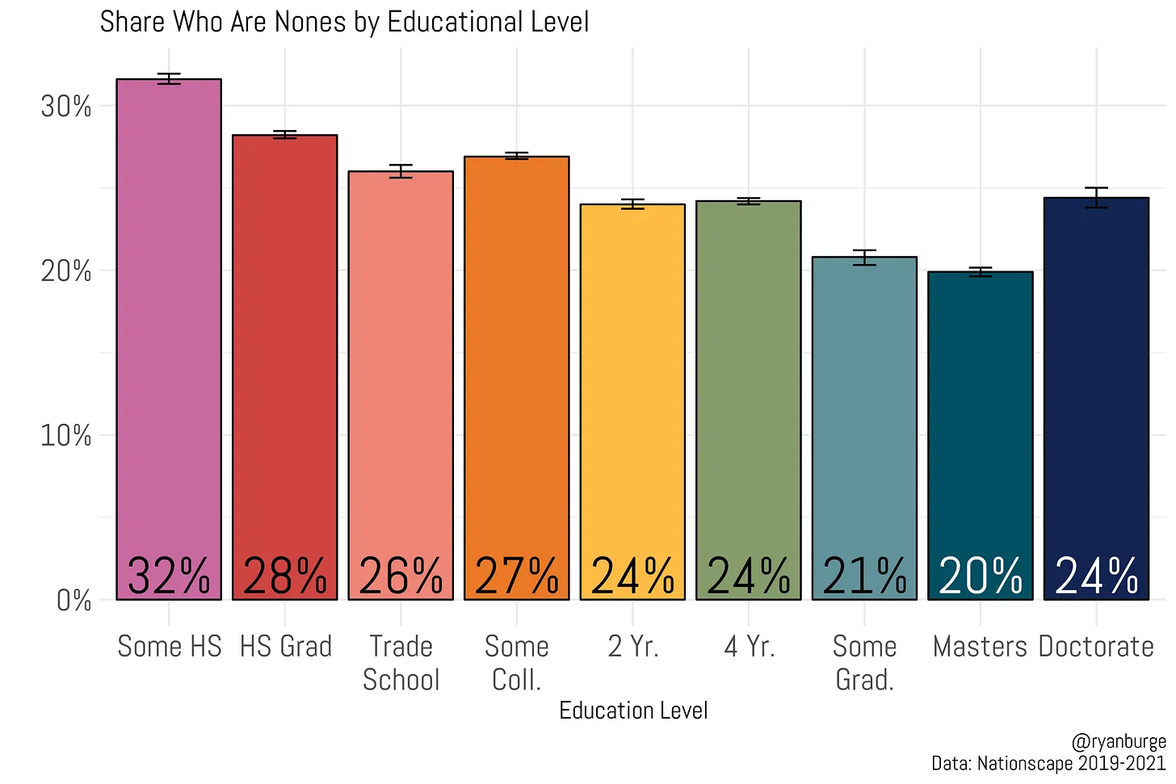
“Religion has become a luxury good.”
So says Ryan Burge, a sociologist who has dug as deep as anyone into data about American worship attendance and religious participation. He leads a landmark new study on religious “nones” in the United States – ”nones” being Americans disaffiliated from religious attendance.
Burge found that the people most likely to attend Christian worship have a master’s degree and earn a salary between $60k and $100k. Intending to sound warning bells, he wrote in 2023:
“Increasingly religion has become the enclave for those who have lived a “proper” life. College degree, middle class income, married with children. If you check all those boxes, the likelihood of you regularly attending church is about double the rate of folks who don’t.
“[Church has] become a hospital for the healthy. An echo chamber for folks who did everything “right”, which means that is seeming less and less inviting to those who did life another way.”
I’m still chewing on this; I came upon it just this week. I don’t have any conclusions or lessons to draw from it. I just don’t want to be the only one chewing on it.
When you consider the churchgoers you know, at Zion and beyond, does Burge’s assessment ring true? What do you think this reveals about Zion – who we are, what God is leading us to do or change?
I encountered Burge’s analysis in an article by Melissa Florer-Bixler in May’s issue of The Christian Century. What she adds is a view from Black churches and historical examples of faithful movements among working-class Americans, like the Azusa Street Revival and the People’s Institute of Applied Religion. She means to give us homework.
Learning about the past can spark our imaginations for the present day. For example, the leaders of the People’s Institute, she says,
“knew from their own lives that the southern poor weren’t looking for handouts. They were natural leaders whose faith and experience were integral to the possibilities for a more just and hopeful society. All they needed were the skills and the support to realize God’s reign among them.”
This is a powerful witness. Even if Zion bucks the trends Burge describes, still the world’s way – the White, middle-class way – of seeing and judging success and a person’s value can cloud our vision. We need stories like these to counter our assumptions about who our neighbors are and what Zion can be in our neighborhood. We have room to grow.
Right now, Zion’s Core Team is leading our efforts to “excite and engage young people.” (Leading – not doing it all by themselves. They need you.) The heart of this work is listening, like the listening we’ve done within Zion but this time among neighbors.
I trust we will discover neighbors who aren’t looking for handouts, who are natural leaders, who are potential partners in making this a more just and hopeful city. I trust God will show us all – Zion listeners and neighbors – what we need to realize God’s reign among us together.
Pastor Clark